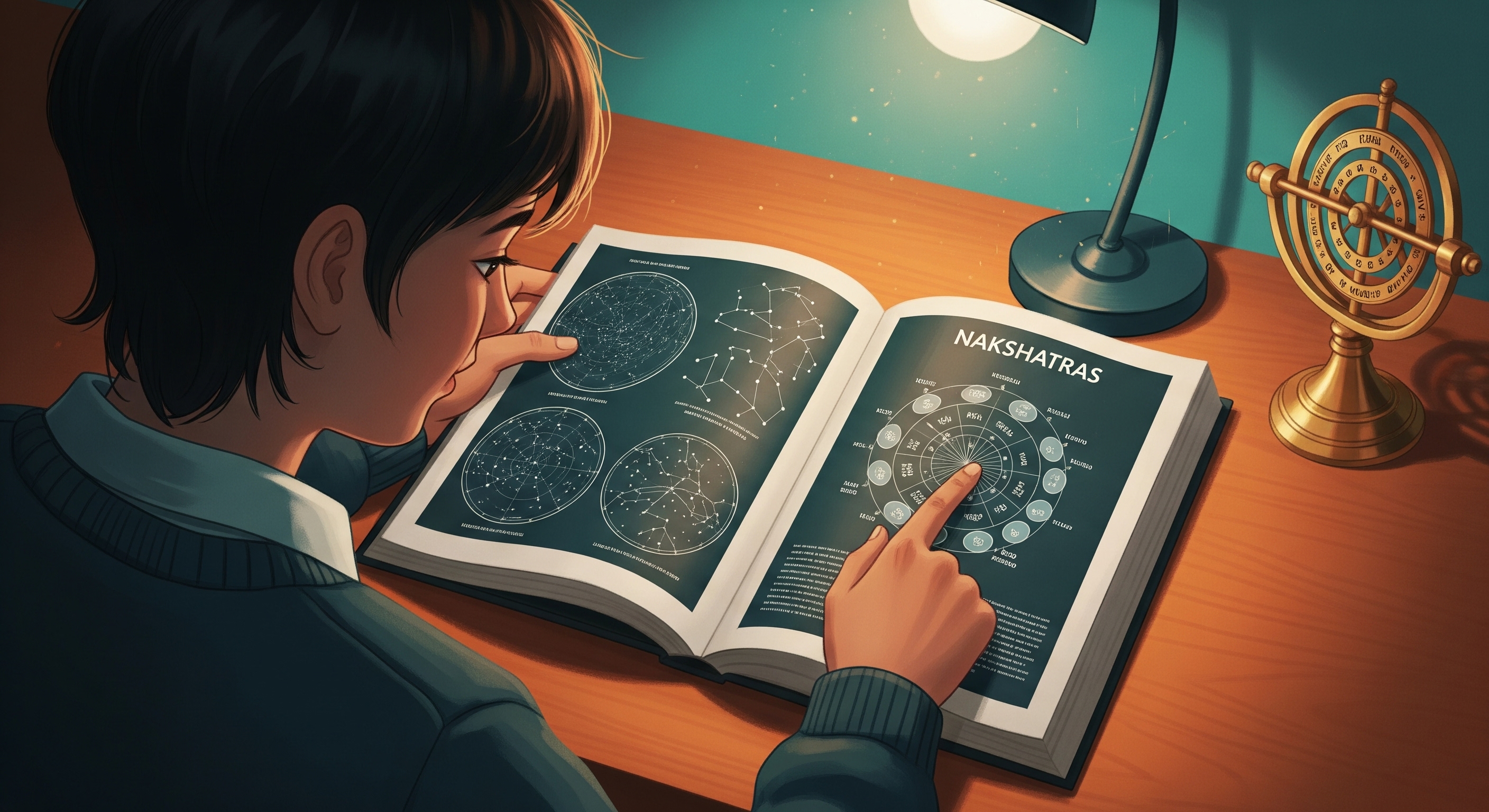
Your KTPI exam asks: "Explain how ancient Indian astronomers predicted eclipses accurately." You know they could do it, but the textbook explanation confuses you. Sanskrit terms feel overwhelming. The connection between mythology and science isn't clear.
This happens to KTPI students every year. They memorize Rahu-Ketu stories and Saros cycle facts separately, never understanding how they connect.
Our new Astronomy in Ancient India guide fixes this problem.
What Makes This Guide Different
Stop losing marks on KTPI astronomy questions. This 25-page guide transforms complex concepts into exam-ready knowledge using conversational 8th-grade English.
The Seven-Component Breakdown:
Every astronomy concept is explained through a simple framework. What ancient Indians observed. How they interpreted it. Why their methods worked. How it connects to modern science. What exam questions test. This structure repeats across all chapters, making patterns easy to recognize.
Real Understanding, Not Memorization:
The Rahu-Ketu myth isn't superstition—it's sophisticated astronomy teaching. Once you understand that Rahu represents the ascending node and "swallowing" describes eclipses at nodes, exam questions become straightforward. We decode every myth, explain every calculation, and connect every concept.
Exam-Focused Throughout:
The guide includes multiple-choice questions with complete explanations, 8 short-answer practice questions, chapter summaries for quick revision, and a glossary defining all Sanskrit terms in simple English.
What You'll Master
The Indian Calendar System
Understand why Diwali falls on different dates each year. Learn what tithi, vara, nakshatra, yoga, and karana actually mean. Grasp why lunar and solar calendars need periodic adjustments.
27 Nakshatras Explained
Discover why the sky divides into exactly 27 sections. Learn which stars belong to which nakshatra. Understand how ancient farmers used them for planting seasons.
Eclipse Prediction Methods
Ancient Indians predicted eclipses centuries ahead without computers. Learn the Saros cycle pattern they discovered. Understand the astronomical truth behind Rahu-Ketu mythology.
Famous Indian Astronomers
Aryabhata calculated year length accurate to within 3.4 minutes—in 499 CE. Brahmagupta was first to treat zero as a number. Varahamihira figured out moonlight is reflected sunlight. Meet the geniuses who made these discoveries.
Jantar Mantar Observatory
Explore why Maharaja Jai Singh II built three-story-tall sundials in 1724. Understand how these massive instruments achieved remarkable precision. Learn what makes them architectural and scientific marvels.
Ancient Meets Modern
See what ancient Indians got right (surprisingly accurate calculations), what they couldn't know (galaxies, black holes), and why both matter for understanding India's scientific heritage.
Inside the Guide
Pages 1-2: Title page and table of contents
Pages 3-5: Why ancient Indians studied the sky
Pages 6-8: Indian calendar system explained
Pages 9-11: Nakshatras and star groups
Pages 12-14: Predicting eclipses without computers
Pages 15-17: Famous Indian astronomers
Pages 18-20: Jantar Mantar observatory
Pages 21-23: Ancient knowledge meets modern science
Pages 24-28: Practice questions with complete answer key
Perfect For
CBSE Class XI students preparing for KTPI exams. Anyone struggling with textbook explanations. Students who memorize facts but can't explain connections. Anyone curious about India's scientific heritage.
How to Use This Guide
Start with Chapter 1 to understand why ancient people studied stars. Chapters build on each other, so read sequentially. After each chapter, try the practice questions. Use the glossary whenever you encounter unfamiliar Sanskrit terms. Review chapter summaries before exams.
Download Your Copy
The Astronomy in Ancient India guide is available now as a 25-page PDF.
Download KTPI Astronomy Guide (₹199)
Perfect for studying on your phone during commute or printing key sections for offline review. No internet required after download.
About the Author
Shambhavi Thakur is an instructional designer with 15+ years of experience creating CBSE study materials. Based in Vrindavan, UP, she specializes in making ancient Indian knowledge accessible to modern students.
Questions? Email info@shambhavithakur.com